


V-belt pulley
General information
A pulley is a drive element that transmits power between the shaft and the transmission belt. Without a pulley, a transmission belt cannot be used. For each type of transmission belt, the corresponding pulley must be used. A V-belt pulley is used for V-belts. A timing belt pulley is used for timing belts. A Poly-V belt pulley is used for longitudinal ribbed belts. A flat belt pulley is used for flat belts.
General information
A pulley is a drive element that transmits power between the shaft and the transmission belt. Without a pulley, a transmission belt cannot be used. For each type of transmission belt, the corresponding pulley must be used. A V-belt pulley is used for V-belts. A timing belt pulley is used for timing belts. A Poly-V belt pulley is used for longitudinal ribbed belts. A flat belt pulley is used for flat belts.
V-belts are used in pulleys with grooves. V-belts cannot be used without pulleys. The V-belt is tensioned in a trapezoidal groove cut into the pulley cover, so that even under higher than normal forces, the force exerted on the shaft does not increase significantly. Standard V-belt pulleys can be manufactured using several mounting methods. The most common is the basic drilled V-belt pulley, also known as a pre-drilled V-belt pulley or a V-belt pulley without holes. This product requires machining. Another very common type is the tapered clamping belt pulley, which does not require machining because a tapered clamp that fits inside the pulley can be selected with a hole suitable for any type of shaft. These products can be found in our selection. If you are looking for a V-belt pulley with a different mounting system, please contact us via our contact details or the contact form.
Flat belt pulleys, toothed belt pulleys, and long-ribbed (Poly-V) belt pulleys are specially designed to accommodate flat, toothed, and long-ribbed belts of the same type (with the same marking). It is not recommended to use flat, ribbed, and toothed belts on pulleys of a different type, as this can drastically reduce their service life!
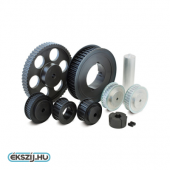
The toothed belt pulley is the drive element for toothed belts (cross-ribbed belts). Its teeth are specially designed to fit the pitch and profile of different toothed belts. They are usually made of steel or aluminum, but very large ones can also be made of cast metal. There are versions with and without flanges, and separate flanges are also available. They are manufactured in fixed widths, but pulleys with custom widths can also be made from toothed bars.
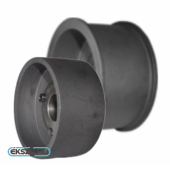
Flat belt pulleys are suitable for driving flat belts of various thicknesses. They share a common feature, which is their barrel shape, which is responsible for the tension of the belt. They are usually made of cast metal. There are versions with and without flanges. They are manufactured in fixed widths.
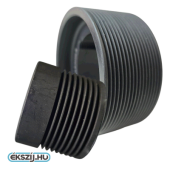
Longitudinal ribbed pulleys are the active element of longitudinal ribbed belts (Poly-V). Their advantage is that they can transmit high torque even at small diameters. The ribs on the pulley correspond exactly to the corresponding belt profile and are not interchangeable. They have a fixed number of ribs, and belts narrower than the number of ribs on the pulley can be used, but wider belts, i.e., belts with more ribs, cannot be used on a pulley with a given number of ribs.
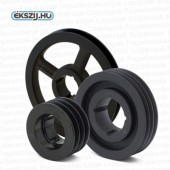

V-belts are used in pulleys with grooves. V-belts cannot be used without pulleys. The V-belt is tensioned in a trapezoidal groove cut into the pulley cover, so that even under higher than normal forces, the force exerted on the shaft does not increase significantly. Standard V-belt pulleys can be manufactured using several mounting methods. The most common is the basic drilled V-belt pulley, also known as a pre-drilled V-belt pulley or a V-belt pulley without holes. This product requires machining. Another very common type is the tapered clamping belt pulley, which does not require machining because a tapered clamp that fits inside the pulley can be selected with a hole suitable for any type of shaft. These products can be found in our selection. If you are looking for a V-belt pulley with a different mounting system, please contact us via our contact details or the contact form.
Flat belt pulleys, toothed belt pulleys, and long-ribbed (Poly-V) belt pulleys are specially designed to accommodate flat, toothed, and long-ribbed belts of the same type (with the same marking). It is not recommended to use flat, ribbed, and toothed belts on pulleys of a different type, as this can drastically reduce their service life!
The toothed belt pulley is the drive element for toothed belts (cross-ribbed belts). Its teeth are specially designed to fit the pitch and profile of different toothed belts. They are usually made of steel or aluminum, but very large ones can also be made of cast metal. There are versions with and without flanges, and separate flanges are also available. They are manufactured in fixed widths, but pulleys with custom widths can also be made from toothed bars.
Flat belt pulleys are suitable for driving flat belts of various thicknesses. They share a common feature, which is their barrel shape, which is responsible for the tension of the belt. They are usually made of cast metal. There are versions with and without flanges. They are manufactured in fixed widths.
Longitudinal ribbed pulleys are the active element of longitudinal ribbed belts (Poly-V). Their advantage is that they can transmit high torque even at small diameters. The ribs on the pulley correspond exactly to the corresponding belt profile and are not interchangeable. They have a fixed number of ribs, and belts narrower than the number of ribs on the pulley can be used, but wider belts, i.e., belts with more ribs, cannot be used on a pulley with a given number of ribs.
News
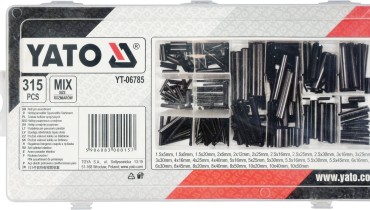 Már Yato szortimentek is elérhetők az ekszij.hu webáruházban
A tengelykötések/kiegészítők termékcsoportban már megtalálhatók különböző Yato szortimentek.
next
Már Yato szortimentek is elérhetők az ekszij.hu webáruházban
A tengelykötések/kiegészítők termékcsoportban már megtalálhatók különböző Yato szortimentek.
next
 Wenn die Maschine stillsteht... német nyelvű bejegyzés
Wenn die Maschine stillsteht und alle auf das passende Ersatzteil warten – kennt ihr diesen Moment in der Werkstatt?
next
Wenn die Maschine stillsteht... német nyelvű bejegyzés
Wenn die Maschine stillsteht und alle auf das passende Ersatzteil warten – kennt ihr diesen Moment in der Werkstatt?
next
 Áramszünet 2026.09.25
Ezúton értesítjük tisztelt vásárlóinkat, hogy a rendelések feldolgozása - előre nem tervezett áramszünet miatt - 2026.09.25-én 12 órától szünetel.
next
Áramszünet 2026.09.25
Ezúton értesítjük tisztelt vásárlóinkat, hogy a rendelések feldolgozása - előre nem tervezett áramszünet miatt - 2026.09.25-én 12 órától szünetel.
next
 INFÓ: Októbertől a S.I.S. Kft üzemelteti a keilriemen.at webáruházat is
Ezúton értesítjük tisztelt vásárlóinkat, hogy 2026. október hónaptól a keilriemen.at webáruházat is a S.I.S. Kft üzemelteti.
next
INFÓ: Októbertől a S.I.S. Kft üzemelteti a keilriemen.at webáruházat is
Ezúton értesítjük tisztelt vásárlóinkat, hogy 2026. október hónaptól a keilriemen.at webáruházat is a S.I.S. Kft üzemelteti.
next